The Fire & the Veil · Foundation of Asha
The Speech Is Not a Colleague
How a fourth-century creed rewrote a first-century hymn
Every popular argument for the deity of Christ commits the same move at the same moment, and the move is invisible to the people making it. A fourth-century confession is imported into a first-century Jewish text, and the import is then called exegesis. The verses get read through the creed, the creed gets confirmed by the verses, and the circle is mistaken for a foundation.
The texts themselves tell a different story. All that is required is to let them speak their own language.
¶ Jurisdiction first
The place to begin is not metaphysics but jurisdiction, because jurisdiction decides everything downstream. Jesus defined his own mission twice, in his own words: "I was not sent except to the lost sheep of the house of Israel" (Matthew 15:24), and to the Twelve, "go nowhere among the Gentiles" (Matthew 10:5). The usual counter is that he came for the whole world. That is not a verse. It is a vibe. The verses that exist say "only," and "only" has never meant "partly."
Even the famous exception proves the rule. The one Gentile healing in the vicinity is granted after the stated scope is argued past, and the metaphor Jesus uses is domestic: the children are fed first, and the little dogs under the table eat after. The Greek word is kynarion, the diminutive, a house animal with a master, not the feral kyon of "do not throw what is holy to dogs." The image is meal order within a single household, and it sits inside a bread cycle that runs from a feeding of thousands in Jewish territory to a feeding of thousands in the Decapolis one chapter later. Israel eats first. The nations eat next. Sequence, not contempt, and certainly not deity dispensing universal citizenship on the spot.
The book of Acts then becomes the control group. If a universal mission had been taught, Acts is unreadable. Peter needs a rooftop vision, years later, just to eat with one Gentile. The apostles litigate Gentile inclusion for two decades. The scattered church preaches "to no one except Jews" (Acts 11:19). The men who lived with him never got the memo, because there was no memo. And every recorded baptism in Acts is performed in Jesus's name alone (2:38, 8:16, 10:48, 19:5); not once does anyone use the triadic formula of Matthew 28:19. Either the apostles disobeyed the risen Lord's final command at every baptism they ever performed, or the formula is later liturgy read back onto the mountain.
¶ A hymn with a pedigree
John 1 is where the creed plants its flag, and John 1 is a Jewish Wisdom hymn in which every line has a pedigree. Wisdom was with God at the beginning, the craftsman beside him (Proverbs 8:22-30). By wisdom the LORD founded the earth (Proverbs 3:19). "You made all things by your word" (Wisdom 9:1). Wisdom is the radiance of eternal light (Wisdom 7:26). Wisdom sought a dwelling among men and found none (1 Enoch 42), so God told her to pitch her tent in Jacob (Sirach 24:8), the same tabernacle verb John reaches for when the Word "dwelt among us."
Jews wrote in this register for four centuries and never once sacrificed to Wisdom, never prayed to her, never counted a second presence at Sinai. Personification is the native grammar of Hebrew praise: Wisdom cries out in the streets, righteousness and peace kiss, innocent blood speaks from the ground. Nobody built any of them an altar. When a Jew says the Word made all things, he is saying God made all things by speaking. He is not introducing a second person. He is describing the first one's breath.
The Greek resists the creed as well. John writes theos without the article in 1:1c, the qualitative construction: "what God was, the Word was," exactly as the New English Bible prints it, following Harner's classic study. If John had meant the Word was the God it was with, the sentence collapses into modalism and eats itself. If he had meant a second god, Greek had clean ways to say so. He wrote the one construction that means God's own self-expression, divine because it is God's own. So yes, all things were made through him: di' autou, instrumental, and a first-century ear hears Psalm 33:6, "by the word of the LORD the heavens were made." God spoke. The speech is not a colleague.
Then comes the hinge, and the hinge is a verb: the Word became flesh. Became. Before that verse there is no man in the poem. After it there is a man, the place where God's self-expression is embodied without remainder. The hymn's own closing line says as much: no one has ever seen God; the Son has made him known, has exegeted him. A human life as God's exegesis is not a modern gloss. It is the prologue's conclusion. There is even a warning label attached: the Septuagint has Wisdom say "the Lord created me at the beginning of his ways" (Proverbs 8:22), which is why that verse spent the fourth century as the most dangerous sentence in the Bible.
¶ The Gospel against the creed
The strange part is that the Fourth Gospel, the supposed fortress of co-equality, keeps testifying for the other side.
John 13:16 states the axiom: the one sent is not greater than the one who sent him. John 14:28 supplies the datum: "the Father is greater than I." The Father sends Jesus roughly forty times across the book. Two premises, both in red letters, and the conclusion writes itself. Whatever sent-ness is, it is not co-equality.
John 17:3 is a prayer, addressed upward: "that they may know you, the only true God, and Jesus Christ whom you have sent." The only true God is spoken to as someone else, and the speaker files himself under "sent."
John 17:21 retires the favorite proof text. "That they may be one even as we are one." Same Greek word, hen, that appears in "I and the Father are one," now applied to the disciples. If oneness in chapter 10 means numerical deity, then chapter 17 drafts fishermen into the Godhead. The oneness is unity of will, and the parallel is fatal.
John 10:34-36 records the accused's own defense. Charged with making himself God, Jesus does not answer "correct." He cites Psalm 82, "I said, you are gods," words spoken to human beings, and restates his claim as "Son of God." The rebuttal to the blasphemy charge is his.
And John 20:31 states the book's thesis outright: these things were written "that you may believe that Jesus is the Christ, the Son of God." A book announces its own verdict. The verdict is Messiah and Son, not a second seat inside the divine essence.
The earliest preaching agrees. The first Christian sermon calls him "a man attested by God," whom "God has made both Lord and Christ" (Acts 2:22, 36). Made. Exaltation, not incarnation. Even the letters keep the prepositions straight: all things are from the Father and through the Son (1 Corinthians 8:6). Source and instrument. The through is not the from.
¶ What was overwritten
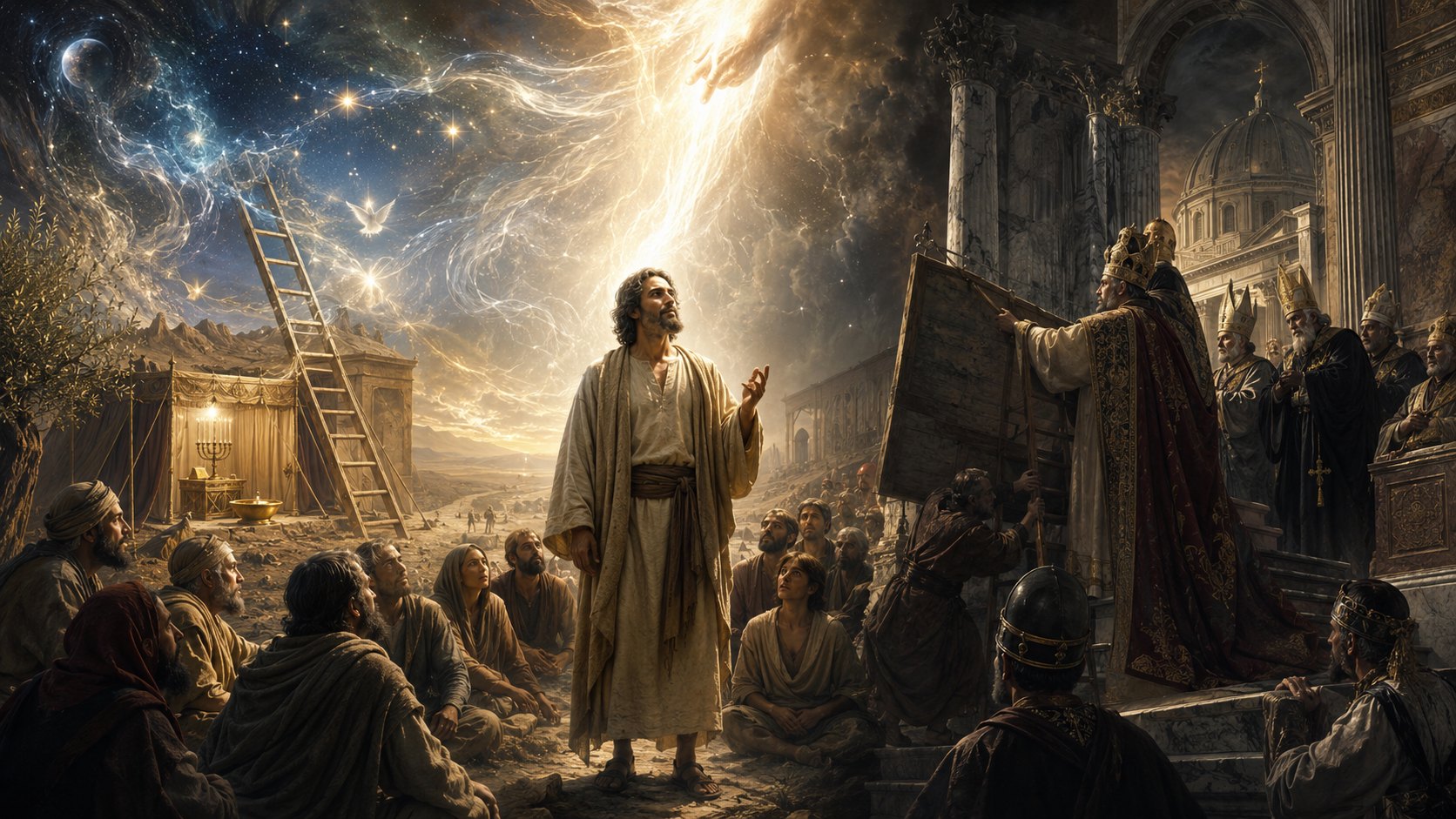
None of this shrinks the figure at the center. It relocates him where the texts place him: the human being in whom God's own Word became flesh, the Son who does nothing of himself, the agent through whom the Father works, the firstborn of a family rather than the exception to one. That reading makes his humanity load-bearing instead of embarrassing. "You are gods" was quoted, not retracted. "Greater works than these" was promised, not hedged (John 14:12). A ladder was set against the wall.
Then an empire needed a God it could crown, and a council obliged. The ladder was pulled up, the agent was promoted to the throne room, the household meal became a closed table, and the remaining architecture was declared eternal. What the creed calls mystery is often just the seam where the older reading was painted over.
The texts are still there. They still speak their own language. The whole recovery project amounts to one discipline: stop translating first-century Jewish scripture into a confession composed three centuries after everyone who knew him was dead, and see what stands up on its own. What stands up is a God who speaks, a Word that is his breath, and a man in whom the breath became visible. That was always the story. It never needed a committee.
¶ Related
The pages that carry the receipts for the claims above:
- What Is the Logos, and the Jewish Memra Behind It?
- Is the Trinity in the Bible?
- Did Jesus Give the Great Commission?
- What Actually Happened at the Council of Nicaea (325)?
- What is the divine council in the Bible?
Get one recovered thing a week.
Sourced religious history, tier-honest, never fabricated. Start with the free book, The Fire and the Veil (PDF, DOI-archived).
Free. One email a week. Unsubscribe anytime. No spam, no fabrication.There is a world you can walk into.
Athena’s Palace is a living world — an agora where positions are argued and settled, a plaza you share with whoever else is awake, and dozens of games besides. Free in your browser, no account needed.
Enter Athena’s PalaceOr go straight there: athenaspalace.comDiscuss this with people who read it too.
Foundation of Asha keeps a Discord for readers working through the Map of Consciousness, the Zohar, the Gospels and the Avesta — five years of archived discussion, and a room that answers.
Join the DiscordPermanent invite: discord.gg/npZ6kBzPj5Reader-funded. No ads, no paywall, no fabrication.